

Hanbin Lee on Pivoting to a Market Small Enough to Win
Forbes Korea “Trend Leading Companies with Jinho Park”, Episode 15: an interview with Hanbin Lee (이한빈) of Seoul Robotics (서울로보틱스) (2023.02). Instead of chasing a dream with infinite variables, a tech company survives by earning first in a market where the variables are limited.
An interview series with the entrepreneurs who will lead Korea over the next decade — 15 innovators beyond beauty, from agtech and AI to robotics, digital therapeutics and F&B. That is why BEAUS COMPANY aims to grow beyond beauty — expanding and thriving together with every Korean industry.
Source: Forbes Korea, 2023.02, 「박진호가 만난 TREND LEADING COMPANIES(15) | 이한빈 서울로보틱스 대표」 · © Forbes Korea · Read the original on Forbes Korea (Korean) ↗
This is BEAUS COMPANY’s own summary and commentary based on the original Forbes Korea article (in Korean). The original article is © Forbes Korea.
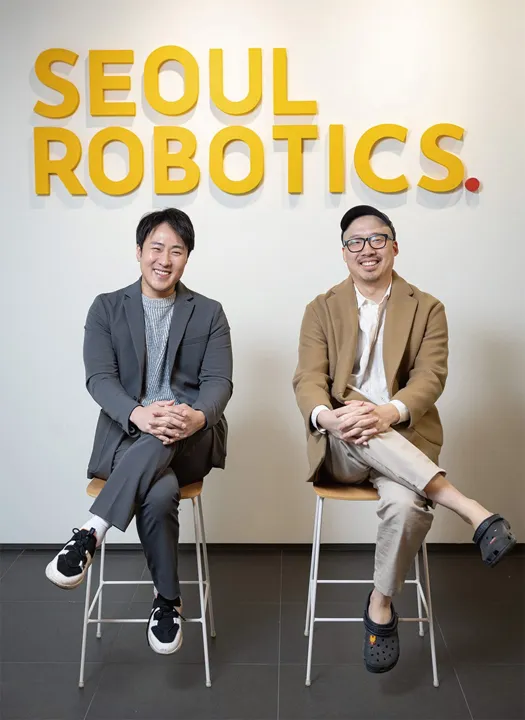
Founded in 2017, Seoul Robotics is an AI software company that processes 3D LiDAR data. It originally developed software for autonomous vehicles, but as the self-driving era kept slipping, it stopped putting LiDAR on cars and pivoted to infrastructure-based autonomy, installing LiDAR on factory pillars, buildings and other infrastructure. Revenue began to grow after the pivot, and in 2022, a year described as an investment winter, the company closed KRW 30.8 billion in funding.
The flagship case is a BMW plant. Newly assembled cars move on their own without drivers, guided by LiDAR sensors installed throughout the site, and at the time of the article about 10% of the plant's vehicle transfers were autonomous. CEO Hanbin Lee pointed to precision within about 4 cm and the ability to analyze data from more than 100 LiDAR units at once as the company's strengths. His reasoning: the risk is lower than on public roads, and in his words it is a market small for big autonomous-driving players but large for a startup.
Moderator Jinho Park opened with the question of whether a fully autonomous car is ultimately impossible. From a marketer's angle, he also floated the idea of using LiDAR to measure foot traffic and actual viewing in front of outdoor billboards. Lee candidly replied that a camera would be enough for that, showing that technology should be matched to the size of the problem.
For Beaus Company, the takeaway is the courage to narrow the market. Without abandoning the bigger vision, focusing technology on a concrete problem customers will pay for today is what brought revenue and investment. In brand and marketing strategy as well, proving value first in a small market that clearly responds, rather than targeting everyone, is the way to the next stage.
Read the full interview on Forbes Korea →
- Seoul Robotics dropped putting LiDAR on cars and pivoted to 'infrastructure-based autonomous driving' with LiDAR mounted on factory infrastructure.
- At the time of the article, about 10% of BMW's plants used autonomous delivery, with finished cars moving on their own without drivers.
- Hanbin Lee named precision within about 4cm and the ability to analyze data from more than 100 LiDAR units at once as key strengths.
- Revenue began to grow after the pivot, and the company closed a KRW 30.8 billion investment in 2022, a year of frozen funding.
- Asked about LiDAR for marketing, Lee said a camera is enough for that information, stressing that technology should fit the size of the problem.
“Many companies are pivoting to somewhat smaller markets where the variables are limited. If you start by knocking on the small doors, the answer will come someday.”
From the interview — Hanbin Lee, Seoul Robotics · Forbes Korea
FAQ
What does Seoul Robotics do?
Founded in 2017, Seoul Robotics is an AI software company that processes 3D LiDAR data. It originally built software for self-driving cars, but now focuses on infrastructure-based autonomous driving, installing LiDAR on infrastructure such as factory pillars and buildings so vehicles can move on their own.
What is the key point of the interview?
It is a pivot story: instead of public-road self-driving with endless variables, the company first earned revenue in a market with limited variables. Hanbin Lee cited autonomous vehicle delivery at BMW plants as the main case, describing a 'small but big market' that is small for large corporations but big for a startup.
What is Seoul Robotics' next goal?
Lee named a Nasdaq listing in 2025-26 as a goal. He said revenue, which was in the KRW 1 billion range two years earlier, doubled last year after the pivot.
Read the full interview on Forbes Korea → About the moderator, Jinho Park
Source: Forbes Korea, 2023.02, 「박진호가 만난 TREND LEADING COMPANIES(15) | 이한빈 서울로보틱스 대표」 · © Forbes Korea · Read the original on Forbes Korea (Korean) ↗
This is BEAUS COMPANY’s own summary and commentary based on the original Forbes Korea article (in Korean). The original article is © Forbes Korea.